Senior psychological consultancy for complex people and high-pressure organisations.

0333 200 1815

Mycore Psychological Consulting

0333 200 1815

  • Welcome
  • Organisations
  • Formulation
  • Menopause in Context™
  • Individual Support
  • NSCTA™
  • About Rebecca
  • Make an enquiry

NSCTA™

Neuro-Somatic Capacity–Threat–Agency

A formulation framework for understanding complexity and informing what happens next. People rarely arrive with one isolated difficulty.


Psychological experience may be interacting with physiology, physical health, sleep, trauma, neurodivergence, hormonal change, relationships, occupational pressure or the wider environment in which someone is trying to function.


NSCTA™ provides a structured way of bringing these influences together through psychological formulation.


At its centre is a simple but important enquiry:

What is affecting capacity? What is signalling or maintaining threat? Where does meaningful agency remain?


Because identifying an appropriate intervention is not necessarily the same as understanding what someone may be ready for.

NSCTA™ currently informs my work in psychological formulation, individual practice and organisational consultancy.


If you are seeking support with a complex presentation, interested in psychological formulation, or would like to discuss the developing professional, research or organisational applications of NSCTA™, you are welcome to get in touch.


Better decisions often begin with better questions.

Ask a question

When One Explanation is Not Enough

 NSCTA™ developed through years of working with people whose experiences did not always fit neatly within a single psychological explanation.


Someone may present with anxiety, exhaustion, overwhelm, reduced concentration or a sense that they are no longer functioning as they once did.


Yet alongside the psychological picture may sit disrupted sleep, persistent pain, hormonal change, neurodivergence, physical health, trauma, grief, occupational exposure, relationship pressures or sustained demands within the environment around them.

Often, several influences are interacting at once.


Different psychological models can illuminate important parts of that experience. NSCTA™ provides a framework for bringing the wider picture together.


It does not seek to explain everything.


Its purpose is to organise complexity sufficiently well that better questions can be asked and better-informed decisions can follow.


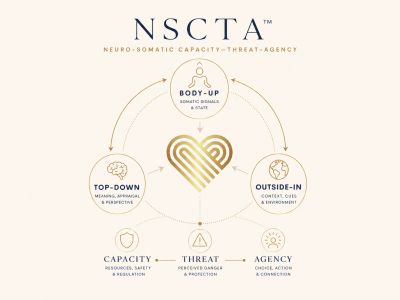
At the centre of the NSCTA™ framework is the Capacity–Threat–Agency model.

The three dimensions are considered as interacting rather than separate.

Capacity–Threat–Agency Model

Capacity

Capacity

Capacity

 What resources are currently available relative to demand?


Capacity is not the same as capability, intelligence, motivation or resilience.


Someone may be highly capable while their available capacity is constrained by sustained stress, poor sleep, pain, physical health, hormonal change, sensory or cognitive load, trauma, emotional demands or insufficient opportunity for recovery.

Threat

Capacity

Capacity

 What is the person or system responding to, anticipating or continuing to protect against?


Threat is broader than immediate danger.


It may be physical, psychological, relational, occupational or environmental. It may relate to something happening now, something previously learned, uncertainty about what may happen next, or conditions requiring sustained vigilance and adaptation.

Agency

Capacity

Agency

 Where does meaningful influence remain?

Agency concerns the person's experience of choice, influence and possibility.


It is not about expecting someone to control circumstances beyond their control. 


Sometimes strengthening agency involves individual action; at other times, the environment or system itself needs to change. Capacity, Threat and Agency continually influence one another.

The formulation lies not simply in identifying each one, but in understanding their relationship.

The formulation lies not simply in identifying each one, but in understanding their relationship.

The formulation lies not simply in identifying each one, but in understanding their relationship.

The formulation lies not simply in identifying each one, but in understanding their relationship.

The formulation lies not simply in identifying each one, but in understanding their relationship.

The formulation lies not simply in identifying each one, but in understanding their relationship.

A Biopsychosocial Lens

How it's applied

 NSCTA™ is applied through a biopsychosocial lens, recognising that biological, psychological and social or contextual influences are interacting parts of a person's experience.


Within that wider lens, Body-Up, Top-Down and Outside-In provide practical directions of enquiry.

Body-Up

 What physiological and somatic influences may be contributing?


This may include sleep, pain, fatigue, hormonal change, sensory processing, physical health, stress physiology and the body's available resources.

Top-Down

 What psychological influences may be shaping the experience?


This includes thoughts, beliefs, memory, meaning, emotional processing, expectations, learning and established patterns of response.

Outside-In

What is happening around the person?


Relationships, responsibilities, work, culture, occupational exposure, organisational structure, leadership, resources and wider environmental conditions may all influence what eventually presents as an individual difficulty.


These are not rigid categories. They provide different directions from which to explore the same interconnected picture.


Body-Up / Top-Down / Outside-In is adapted from Dr Sarah McKay’s model and incorporated within NSCTA™ as directions of enquiry through a biopsychosocial lens. 

NSCTA™ supports that clinical reasoning. It does not replace professional judgement.

NSCTA™ supports that clinical reasoning. It does not replace professional judgement.

NSCTA™ supports that clinical reasoning. It does not replace professional judgement.

NSCTA™ supports that clinical reasoning. It does not replace professional judgement.

NSCTA™ supports that clinical reasoning. It does not replace professional judgement.

NSCTA™ supports that clinical reasoning. It does not replace professional judgement.

The Architecture of NSCTA™


NSCTA™ brings together different levels of psychological thinking without treating them as interchangeable.


NSCTA™ — the formulation framework
Capacity–Threat–Agency — the core formulation model
Biopsychosocial — the overarching lens
Body-Up / Top-Down / Outside-In — directions of enquiry
Formulation-led — the clinical approach
EMDR, CBT and others — therapeutic modalities and interventions
Readiness — professional judgement informed by formulation


Biopsychosocial provides the lens. Body-Up, Top-Down and Outside-In direct the enquiry. Capacity–Threat–Agency organises the formulation. The formulation informs what happens next. 

From Formulation to Readiness

Formulation before intervention

 Knowing what might help is not always the same as knowing whether someone is ready for it.


A person may have insight, motivation and psychological understanding while their wider system remains under significant load.


NSCTA™ helps consider the capacity currently available for therapeutic work alongside the presenting difficulty.


The formulation may support deeper or modality-specific work. At other times, the priority may be stabilisation, restoring capacity, addressing threat, strengthening agency, adapting the environment or seeking additional professional input.


The question is not only “What might help?” but also “What does this person appear ready for now?”

Capacity is not capability

 Someone may remain articulate, insightful and highly capable while the resources available to sustain that functioning are becoming constrained.


They may understand what would help and still struggle to implement it.


NSCTA™ distinguishes capability from available capacity and invites a different question:


What may currently be limiting this person’s capacity to use what they already know?


This opens enquiry into recovery, physiological load, psychological demand and environmental conditions, and helps explain why continued functioning should not automatically be taken as evidence that someone is unaffected.

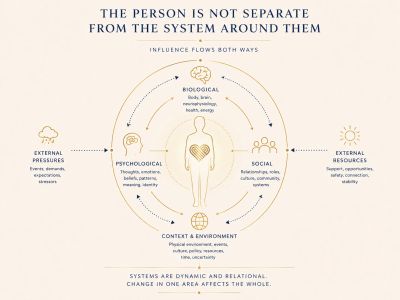
The Person is Not Separate from The System Around Them

People do not function in isolation

An Outside-In direction of enquiry becomes particularly important when psychological difficulties arise within demanding occupational or organisational environments.


It can be tempting to locate the difficulty primarily within the individual their resilience, coping or ability to manage pressure.


NSCTA™ widens the formulation.

At an organisational level, the same Capacity–Threat–Agency model can prompt different questions.


Capacity — are available resources sufficient for the demands being placed on people and the system?

Threat — what conditions may be creating sustained pressure, uncertainty, exposure or vigilance?

Agency — where do individuals, teams and leaders genuinely have influence, and where are they being asked to manage conditions they cannot meaningfully change?


This does not remove individual responsibility or psychological factors from consideration.

It ensures that the wider system is not removed from the formulation either.


Sometimes an individual difficulty tells us something important about the environment in which that person is trying to function.
Grounded in Research. Clear About What Comes Next.

Research-informed - transparently developing

 NSCTA™ integrates established research across allostasis, interoception, threat processing, trauma, learning and agency.


Its developing contribution lies in how these influences are organised through the Capacity–Threat–Agency model, viewed through a biopsychosocial lens and explored using Body-Up, Top-Down and Outside-In directions of enquiry, adapted from Dr Sarah McKay’s work.


NSCTA™ is a research-informed developing formulation framework. It is not a diagnosis, psychometric test or therapeutic modality.


It supports formulation, pacing and professional judgement about what may be appropriate next.


The framework will develop at the pace of the evidence supporting it.

Selected research foundations

NSCTA™ draws on established bodies of research informing the concepts within the framework. 


Selected work includes;

 Craig (2009) on interoception and awareness; 

Ganzel et al. (2010) and Sterling (2012) on allostasis and predictive regulation; 

Shin and Liberzon (2010) on fear and stress neurocircuitry; Moore and Fletcher (2012) and Braun et al. (2018) on sense of agency; Craske et al. (2014) on inhibitory learning; 

Farb et al. (2015) on interoception; and more recent work examining allostatic overload, threat processing and agency.


These references inform the theoretical foundations of NSCTA™; they should not be interpreted as evidence validating the framework itself. 


A fuller evidence map and reference base will accompany the framework's ongoing professional and research development.

The Roots of Systems Thinking

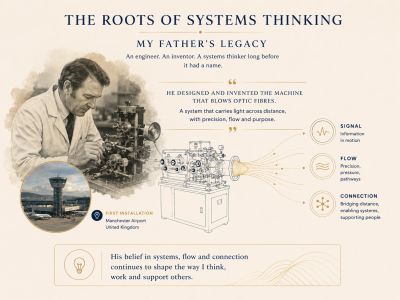
My Father’s Legacy

Systems thinking influenced me long before I entered psychological practice.


Growing up around an inventor and engineer, I was exposed early to conversations about pressure, flow, signalling, pathways and how systems respond when conditions change.


Years later, some of those questions began to resonate with what I was observing in psychological and organisational practice.


Human beings are not engineering systems, and the analogy has important limits. But systems thinking encourages useful questions about load, capacity, signalling, adaptation and the conditions within which a system is being asked to function.


Combined with my clinical and organisational experience, these ideas contributed to the thinking that eventually developed into NSCTA™.


The interest has always been less in what appears to be failing, and more in understanding the conditions under which the system is trying to function.
Developed by Rebecca Downes

 NSCTA™ is an original developing formulation framework created by Rebecca Downes, Senior Psychological Practitioner and BACP Accredited Psychotherapist, through Mycore Psychological Consulting Ltd.


The framework reflects the convergence of psychological practice, organisational experience and an ongoing interest in understanding people within the wider systems in which they live and work.


© 2026 Mycore Psychological Consulting Ltd. All rights reserved.

 © 2026 Mycore Psychological Consulting Ltd. All rights reserved. | Privacy & Data Protection | Legal & IP 

  • Make an enquiry
  • Privacy & Data Protection
  • Legal & IP

Powered by

This website uses cookies.

We use cookies to analyze website traffic and optimize your website experience. By accepting our use of cookies, your data will be aggregated with all other user data.

DeclineAccept